Buying a compressor that is "a bit bigger to be safe" is the most expensive mistake we see in workshops. Oversized compressors waste electricity every minute they run; undersized ones overheat, trip on thermal overload, and shorten the life of the motor. The fix is to size by the numbers, not by feel.
The 4 numbers that matter
Sizing comes down to four values, in this order:
- CFM — Cubic Feet per Minute of free air the compressor must deliver.
- PSI / bar — the pressure your tools need at the inlet.
- Duty cycle — how much of the hour the compressor will actually be running.
- Tank size — how much stored air buffers short bursts.
Get CFM right and the rest follows. Get it wrong and no amount of tank size will save you.
Step 1 — Add up your tool CFM
List every pneumatic tool that will run at the same time. Take the manufacturer's CFM rating at the tool's working pressure (usually 90 PSI / 6.2 bar). Typical values:
| Tool | CFM @ 90 PSI |
|---|---|
| 1/2" impact wrench | 4–5 |
| Tire inflator | 2 |
| HVLP spray gun | 9–12 |
| Die grinder | 5–8 |
| Sandblaster (small) | 10–20 |
| Plasma cutter | 6–8 |
Add the CFM of every tool that will run simultaneously. Not every tool you own — only the ones that will be triggered together. In a 3-bay tire shop with one impact wrench per bay running at once, that is 3 × 5 = 15 CFM.
Step 2 — Apply the duty-cycle multiplier
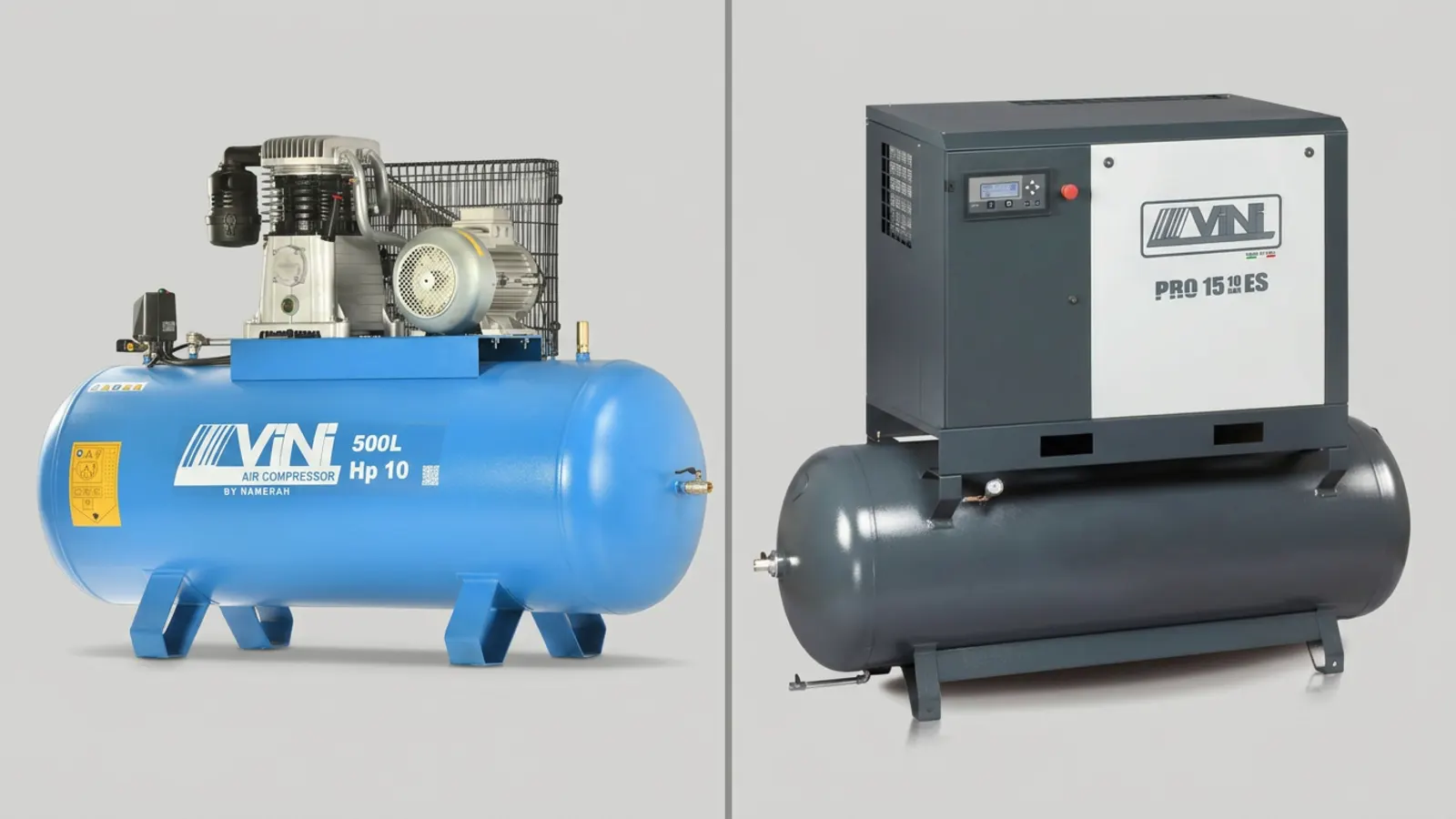
Piston (reciprocating) compressors suit intermittent demand and need rest between cycles, so allow headroom above your calculated CFM; rotary screw compressors suit sustained or continuous demand. Follow the duty limits stated in the operating manual for the exact model.
- Tire shop example, piston: 15 × 1.25 = 19 CFM required.
- Same shop, screw: 15 × 1.0 = 15 CFM required.
Step 3 — Pick the working pressure
The industrial workshop standard is 10 bar (145 PSI). This gives headroom for hose-and-fitting pressure drop so your tools still see 90 PSI at the inlet. All Namerah compressors are rated at 10 bar working pressure.
Step 4 — Size the tank
The tank stores air between motor cycles. Bigger tank = fewer starts = longer motor life. Rule of thumb for piston compressors:
- Up to 5 HP → minimum 200 L tank.
- 5.5–7.5 HP → 300–500 L tank.
- 10 HP → 500–1000 L tank.
- Rotary screw → tank-mounted units typically pair 20 HP with 500 L; larger screws use a separate receiver.
If your demand is bursty (sandblasting, paint booth), oversize the tank one step — the buffer is easier than upsizing the motor.
A quick lookup table
| Workshop type | Tools running together | Recommended setup |
|---|---|---|
| Tire shop (3 bays) | 3 impact wrenches | Piston 200 L 3 HP or 300 L 4 HP |
| General auto repair | Impact + die grinder + inflator | Piston 500 L 7.5 HP |
| Paint / body shop | 2 spray guns + sander | Piston 500 L 10 HP or Screw 20 HP |
| Tire fleet / 24-7 demand | Multiple bays continuous | Screw 20–30 HP + 500 L receiver |
| Light manufacturing | Production line tools | Screw 50–100 HP + receiver |
Common mistakes to avoid
- Sizing by HP alone. Two compressors with the same HP rating can deliver very different CFM. Always compare CFM at your working pressure.
- Ignoring leaks. A typical workshop loses 20–30% of compressed air to leaks. Fix them before upsizing.
- Mounting too far from the tools. Long, narrow hoses cause big pressure drops. Use 1/2" hose for high-CFM tools and keep runs short.
- Using a piston for 8+ hour days. That is what rotary screw is built for.
When to call us
If you cannot find your tool's CFM rating, or you are not sure what duty cycle your day looks like, send your tool list and a description of your busiest hour. Send the list and operating pattern so our team can review the required capacity.