An undersized air receiver tank is the fastest way to burn out a compressor motor. An oversized one wastes floor space and can lengthen unloaded run time. Get the sizing right the first time and you buy yourself years of reliable, low-cycling operation. This guide covers the working formula, a quick lookup table from 50 L to 10,000 L, and the sizing rules our engineers use every week.
What an air receiver tank actually does
The receiver is not just "storage" — it does four jobs:
- Buffers demand spikes so the compressor does not short-cycle every time a tool triggers.
- Cools the discharge air, letting water and oil drop out before they reach line filters.
- Stabilises system pressure so tools see steady CFM at the inlet.
- Reduces motor starts — every start is what kills electric motors, not run time.
The 4-step sizing method
Step 1 — Know your compressor's FAD
Free Air Delivery is the CFM (or L/min) the compressor actually pushes into the tank at your working pressure (10 bar). Take it from the spec sheet, not the horsepower.
Step 2 — Choose a target cycle time
For a piston compressor, aim for a maximum of 10 starts per hour (one every 6 minutes). Rotary screw compressors that load/unload should hit 4–6 cycles per hour minimum unloaded time of 2 minutes to protect the airend.
Step 3 — Apply the formula
For piston compressors, the classic receiver formula is:
V (litres) = (Q × Pa × t) / (Pmax − Pmin)
Where:
- Q = compressor FAD in L/min
- Pa = atmospheric pressure ≈ 1 bar
- t = target time between starts in minutes
- Pmax − Pmin = pressure swing (typical 10 → 8 bar = 2 bar)
Worked example: a 5.5 HP piston delivering 500 L/min, target 6 min between starts, 2 bar swing. V = (500 × 1 × 6) / 2 = 1,500 L / 2 = 500 L tank.
For rotary screws, use a simpler rule of thumb: 10 litres of receiver per 1 CFM of FAD at 10 bar for load/unload control, or 4 L per CFM if the unit runs on VFD.
Step 4 — Add a demand buffer
If your load is bursty (sandblasting, paint booth, plasma cutter), oversize the calculated volume by one step — buffer is cheaper than a bigger motor. If your load is smooth (production-line air tools), the calculated size is fine.
Quick lookup — 50 L to 10,000 L
| Compressor | Typical FAD | Receiver (smooth demand) | Receiver (bursty demand) |
|---|---|---|---|
| 2 HP piston (single-phase) | ~250 L/min | 50–100 L | 150–200 L |
| 3 HP piston | ~350 L/min | 150–200 L | 300 L |
| 5.5 HP piston | ~500 L/min | 300–500 L | 500 L |
| 7.5 HP piston | ~700 L/min | 500 L | 500–1,000 L |
| 10 HP piston | ~950 L/min | 500–1,000 L | 1,000 L |
| 20 HP screw | ~85 CFM (2,400 L/min) | 500 L | 1,000 L |
| 30 HP screw | ~125 CFM (3,540 L/min) | 1,000 L | 1,500–2,000 L |
| 50 HP screw | ~212 CFM (6,000 L/min) | 2,000 L | 3,000 L |
| 100 HP screw | ~430 CFM (12,180 L/min) | 4,000–5,000 L | 8,000–10,000 L |
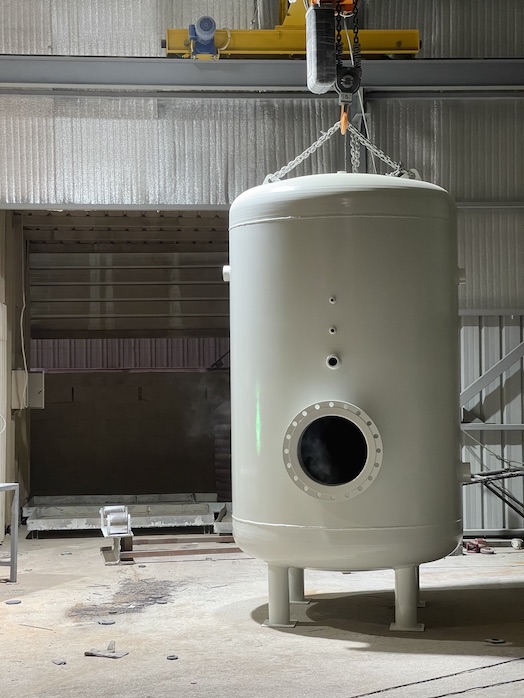
All sizes above are available in the Namerah air receiver tank range — vertical for tight floor plans, horizontal for lower ceilings.
Vertical vs horizontal — how to choose
- Vertical is the default for workshops. Smaller footprint, easier to plumb, condensate collects cleanly at the bottom drain.
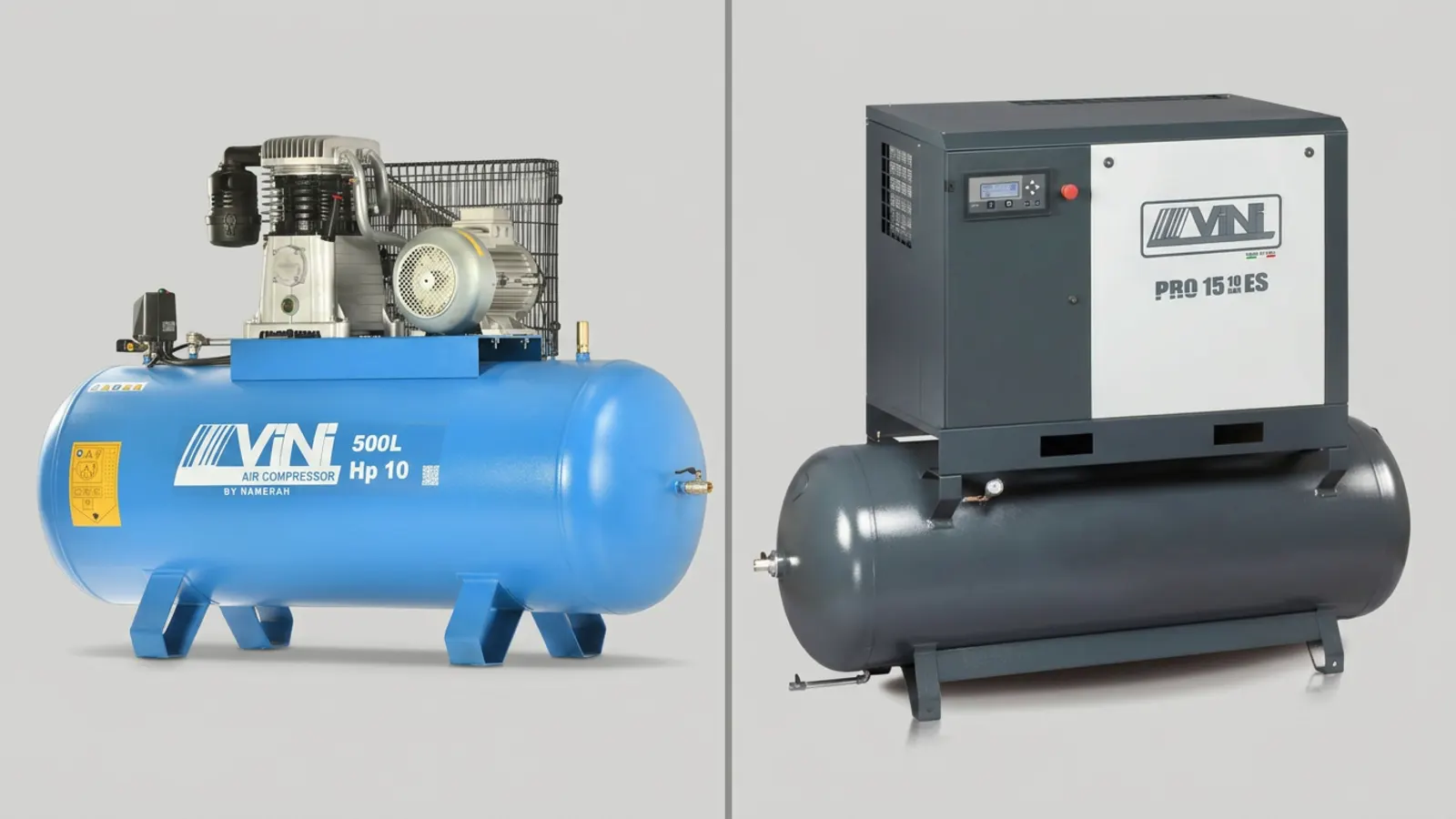
- Horizontal is better when ceiling height is limited or when the tank doubles as a base for mounting the compressor (common on 500 L / 10 HP piston skid units).
- Both work equally well thermally — pick by installation constraint, not performance.
Pressure rating — 10 bar or 16 bar
- 10 bar tanks match every standard workshop and industrial system where the compressor cuts out at 10 bar.
- 16 bar tanks are needed when the compressor is spec'd for high-pressure applications (PET bottling, some cutting operations) or when the safety code requires 60% headroom over working pressure.
Order the tank rating to match the compressor's maximum discharge — never below.
What derates a receiver in Saudi conditions
- Ambient temperature above 40 °C — no volumetric change, but condensate load doubles. Fit an auto-drain, not a manual valve.
- Coastal humidity — the tank interior corrodes faster. Specify an internal epoxy lining or stainless drain fittings.
- Sandstorms — external paint takes a beating. A repainted tank every 3–4 years is cheaper than a replacement in year 8.
Common sizing mistakes
- Using HP instead of FAD. Two 10 HP compressors from different makers can deliver 850 vs 950 L/min. The tank needs the real flow.
- Ignoring simultaneous demand. A 3-bay tire shop that runs 3 impact wrenches together is not the same as a 3-bay shop that only fires one at a time.
- Skipping the drain. A tank with no working drain rusts through in Saudi humidity in 5–7 years. Auto-drain is not optional.
- Placing the tank in a hot room. A receiver in a 55 °C compressor room condenses less water and passes more of it to your line filters. Vent the room or duct the tank inlet from cooler air.
Where to install the receiver
- After the compressor discharge and before the dryer, so the tank does its cooling job first and the dryer sees pre-cooled air.
- On a level, ventilated surface with 500 mm clearance around the shell for inspection.
- Never inside a paint booth or a fuel-storage room — the tank is a pressure vessel and needs an accessible relief valve path.
Related reading
- How to size an air compressor for your workshop — the CFM side of the same problem.
- Screw vs piston compressor — sets the load/unload cycle your receiver has to buffer.
- Air compressor maintenance checklist — how the receiver drain fits into your daily routine.
FAQ
How big a tank do I need for a 5.5 HP piston? For a workshop with smooth intermittent tool use, a 300–500 L tank at 10 bar. For a paint or sandblasting bay, jump to 500 L minimum.
Do rotary screws need a receiver tank? Yes. Even a "tank-mounted" 20 HP screw benefits from an additional 500 L receiver downstream — it stabilises pressure and keeps load/unload cycles above 2 minutes.
Can I oversize the tank? Up to a point. Doubling the calculated volume is fine; going 4–5× larger delays pressure recovery and extends unloaded run time, which wastes energy on screws.
Vertical or horizontal for a 500 L tank? Vertical if you have 2 m of ceiling clearance — it takes less floor space. Horizontal only when you need the compressor bolted on top or ceiling height is limited.
When do I need a 10,000 L tank? For 75–100 HP screws feeding a large plant, or when the site has short, extreme demand spikes (bottle blowing, large sandblasting). Below 50 HP, 2,000 L is usually the ceiling.
Need help sizing? Send us your compressor model and daily tool list — we will calculate the receiver, dryer, and filter set in one quote for your site.