Most "screw vs piston" articles compare the two machines the way you'd compare cars in a showroom. That framing is wrong for a factory. At factory scale, the right question is not which type is better — it is: what combination of machines delivers your load profile at the lowest total cost of ownership? This guide walks through that decision the way a plant engineer actually makes it.
1. Build the load profile first
Do not spec anything until you have a real load profile. For each pneumatic consumer, record:
- CFM at operating pressure (from the tool's technical spec, not marketing sheet).
- Simultaneous-use factor — how many will run at the same instant, honestly.
- Duty cycle over the working hour — impact wrenches burst then idle; laser cutters and packaging lines run flat.
Output three numbers:
- Peak simultaneous CFM — the demand during the busiest 30-second window.
- Average CFM over the shift — the total scfm × hours divided by shift length.
- Load variability — peak ÷ average. Below 1.5 = flat; above 2.5 = spiky.
These three numbers drive every downstream decision.
2. Sizing rules of thumb by machine class
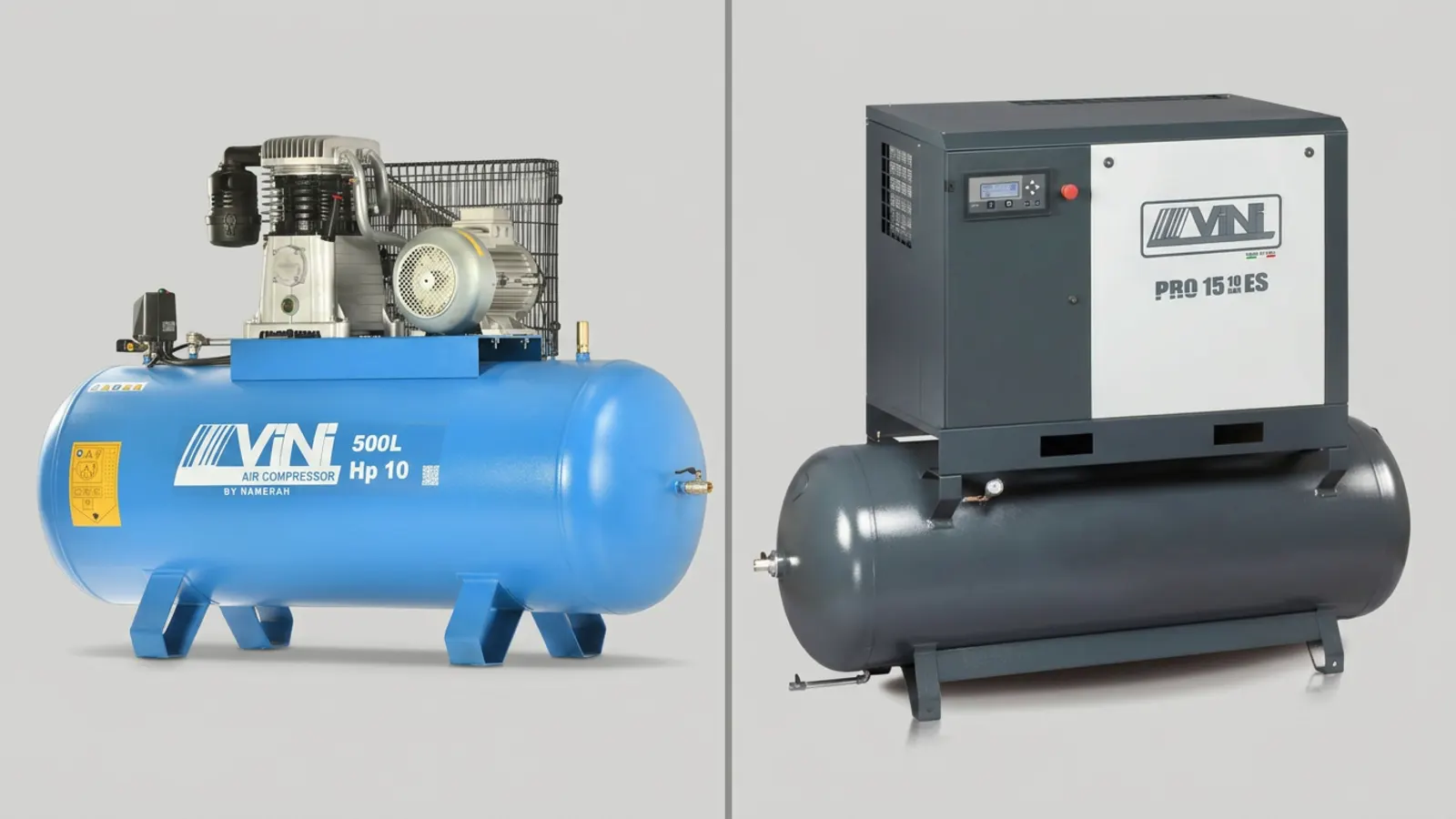
| Machine class | Duty cycle | Best when… | Weak when… |
|---|---|---|---|
| Single-stage piston | 50–60% | Intermittent workshop use, small footprint, low capex | Continuous run, high heat, higher noise |
| Two-stage piston | 70–75% | Higher-pressure niche applications, workshop with mid-duty | Still not for 24/7 process |
| Fixed-speed screw | 100% | Flat continuous demand at design point | Very variable demand (idles wasteful) |
| VSD (inverter) screw | 100%, 25–100% modulating | Variable demand ±25% across shift | Flat demand at full load (VSD adds cost) |
| Multi-unit screw (N+1) | 100% | Large plants needing redundancy | Very small plants (overkill) |
3. When a piston bank actually wins
Engineers often assume a single screw beats a bank of pistons. Not always. A piston bank is the right answer when:
- Total demand is under 100 CFM.
- Duty cycle is genuinely under 60% (measured, not guessed).
- The plant has cold-standby capacity — one piston tripping does not stop production because you have three others.
- Capex is capped and grid electricity is cheap.
- Service culture prefers in-house valve overhauls over screw-airend swaps.
A well-maintained piston bank in N+2 configuration — one spare unit beyond redundancy — can comfortably run multi-shift production with planned rotation for service, so no single unit failure interrupts output. It is not the "modern" answer — but for the right load profile, it is the right one.
4. When a single VSD screw wins
A single VSD (variable-speed drive) screw is the right answer when:
- Demand varies more than ±25% across the shift.
- Plant runs 12+ hours/day, most days.
- Compressor room has proper ventilation (see the KSA manufacturing sizing guide).
- Electricity cost is meaningful (SAR 0.15/kWh+).
- Zero-air-loss during changeovers is a requirement.
Energy savings versus a fixed-speed screw of the same size are application-dependent; estimates commonly quoted are around 20–35% on variable loads and 5–10% on nearly flat loads. Treat them as estimates to be verified against your own load profile, not guaranteed results.
5. When multi-unit (N+1) screws win
Multi-unit N+1 fixed-speed screws win when:
- Peak demand exceeds 200 CFM.
- Loss of air stops production.
- Load profile is stepped (one shift high, one shift low) — you shut off units as demand drops.
- 24/7 continuous operation makes VSD wear-life concerns real.
A classic setup: two 50 HP screws + one 30 HP VSD screw. The VSD trims, the 50s carry base, either 50 can drop for service. The plant never loses air. This is the standard we deploy for continuous-process customers.
6. The break-even table
For an average KSA industrial plant, running 6,000 hours per year at SAR 0.18/kWh, the break-even points work out roughly:
| Peak demand | Load variability | Best answer |
|---|---|---|
| < 30 CFM | any | Single/twin piston |
| 30–80 CFM | flat | 2× piston or one small fixed-speed screw |
| 30–80 CFM | spiky | One 20–30 HP VSD screw + big receiver |
| 80–200 CFM | flat | Single fixed-speed screw (30–50 HP) |
| 80–200 CFM | spiky | Single VSD screw (30–50 HP) |
| 200–500 CFM | flat | N+1 fixed-speed screws (2×50 HP or 50+30) |
| 200–500 CFM | spiky | 1 VSD lead + 1 fixed-speed base |
| > 500 CFM | any | Multi-unit screw plant with master controller |
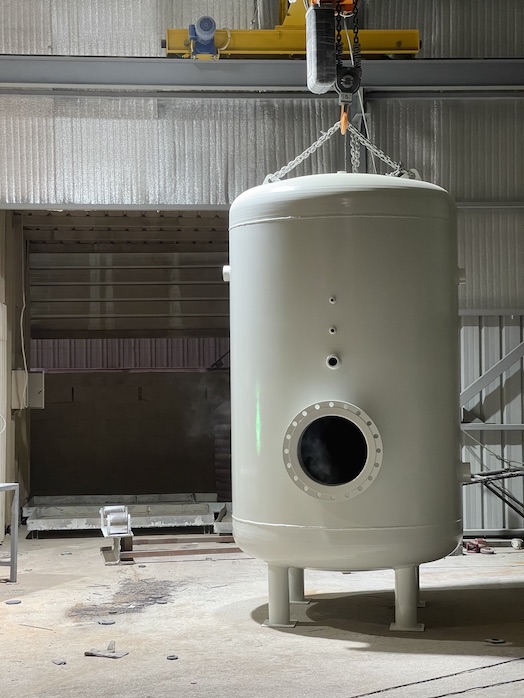
7. Tank sizing — the multiplier every guide skips
A properly sized receiver tank changes which compressor you need. Rule of thumb:
Tank litres = (Peak CFM × 2.83) × required buffer minutes × 60 / (P_max − P_min)
Where P_max − P_min is your allowable pressure band (typically 1 bar).
Example: 150 CFM peak, 1-minute buffer, 1-bar band → ~25,500 litres. Practically, that means a 3,000–5,000 L main receiver plus point-of-use receivers at spike consumers. A big tank lets a smaller compressor handle a spikier load — this is the cheapest efficiency lever in most plants.
See our tank sizing guide for the full method.
8. Pressure-drop budget across the ring main
A compressor rated at 10 bar loses pressure to every fitting and metre of pipe:
| Element | Typical drop |
|---|---|
| Dryer | 0.15–0.25 bar |
| Coalescing filter | 0.20–0.30 bar (clean); 0.7 bar (change point) |
| Activated carbon filter | 0.10 bar |
| Ring-main pipe run (100 m at correct diameter) | 0.10–0.20 bar |
| Hose whip and fittings at point-of-use | 0.30–0.50 bar |
Budget 1.5–2.0 bar of total drop from compressor discharge to tool inlet. If tools need 6.2 bar (90 PSI), your compressor must produce 8 bar minimum — which is why 10 bar is the KSA industrial norm.
9. Worked example — 40-worker fabrication plant
Load profile:
| Tool | Qty | CFM each | Sim-use factor | Effective CFM |
|---|---|---|---|---|
| 1/2" impact wrench | 8 | 5 | 0.35 | 14 |
| Die grinder | 6 | 6 | 0.40 | 14.4 |
| MIG plasma cutter | 2 | 12 | 0.60 | 14.4 |
| Sandblast cabinet | 1 | 45 | 0.70 | 31.5 |
| Spray gun (2K) | 2 | 8 | 0.50 | 8 |
| Chuck / clamp actuators | 12 | 0.5 | 1.0 | 6 |
Totals:
- Peak simultaneous CFM ≈ 88 CFM
- Add 20% growth headroom → 106 CFM design target
- Add 25% for KSA ambient derate at 50 °C → 132 CFM installed capacity
- Load variability = high (sandblaster dominates)
Answer: One 30 HP VSD screw (~125 CFM at 10 bar), 2,000 L receiver, refrigerated dryer + 5 µm / 0.01 µm / carbon filter train. A fixed-speed 30 HP would work too but wastes 15–20% on the spiky demand profile. Two 20 HP fixed-speed screws would give redundancy but at higher capex and no efficiency gain over one VSD.
10. Common sizing mistakes
- Sizing on the tool nameplate sum. Adding every tool at 100% duty gives a compressor 2–3× too big. Wasteful, and it short-cycles on the actual load.
- Ignoring pressure drop. A "10 bar" compressor with 3 bar of downstream losses gives tools 7 bar — often not enough for full torque on an impact wrench.
- Skipping the tank. No tank means the compressor cycles on every trigger pull. Kills the airend in 3 years instead of 15.
- Undersizing the dryer. Dryer must be sized on hot, humid inlet — not compressor nominal CFM.
- Choosing on capex alone. The compressor's electricity bill over 10 years is 4–6× its purchase price.
Related reading
- How to choose the right air compressor for KSA manufacturing facilities
- Screw vs piston compressor — which one to buy
- Air receiver tank sizing — from 50 L to 10,000 L
- How to size an air compressor for your workshop
FAQ
Should I always pick a VSD screw for a factory? No. If your load is flat and continuous, a fixed-speed screw is cheaper to buy, has fewer failure modes, and matches VSD efficiency. VSD wins on variable demand only.
Are piston compressors obsolete for factories? No — piston banks still make sense under 100 CFM total demand with low duty cycle. Above that, screws almost always win on TCO.
How much bigger should my compressor be than my peak demand? 20% headroom for growth. The receiver tank handles short-term spikes, not the compressor itself.
When do I need two compressors instead of one bigger one? Any production line where 30 minutes of air loss stops output. N+1 redundancy is cheap insurance.
Can I mix piston and screw compressors? Yes — a common setup is a screw for base load and a piston for peak trim. Works if piped through a common receiver with check valves.
Sizing a compressor room? Send us your tool list and shift pattern — our engineers will build the load profile, size compressor and treatment, and quote for your site requirements.